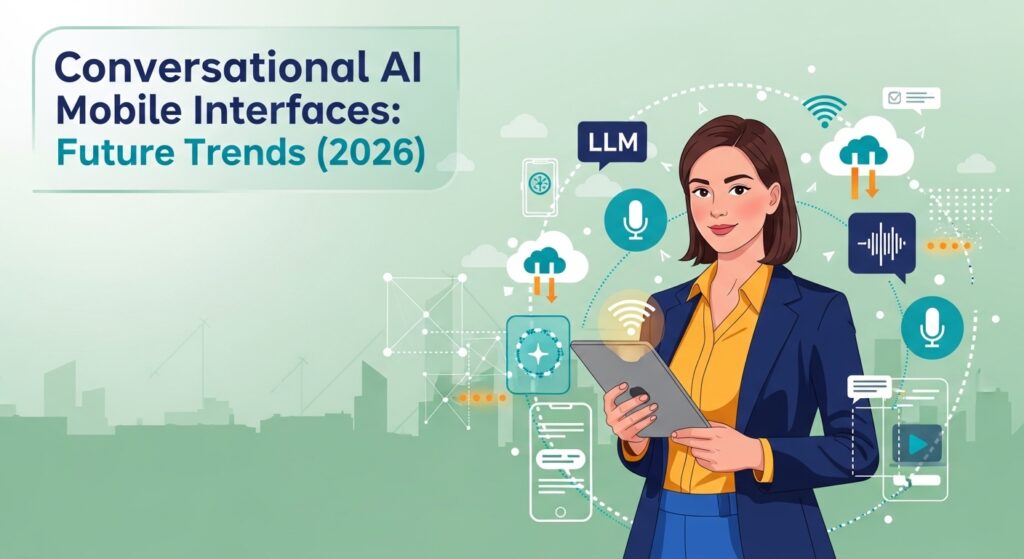
The End of Tapping and Swiping (Or Is It?)
Honestly, I am pretty knackered from scrolling through a thousand menus just to order a coffee or check a flight. We have been stuck in this grid-of-icons hell for too long now.
But real talk, conversational AI mobile interfaces are finally fixin’ to change how we interact with our glowing glass bricks in 2026. It is no longer just a dodgy chatbot popping up to annoy you.
We are seeing a proper shift toward intent-based design where your phone actually anticipates what y’all want before you finish typing a sentence. It feels a bit like magic, or perhaps a bit creepy.
The market is absolutely exploding right now, with analysts suggesting that by late 2026, the global conversational AI market will reach nearly $30 billion. You can see the trajectory at MarketsandMarkets.
The Death of the Traditional Menu
Menus are basically fossils in 2026. Why would you dig through three layers of settings when you can just tell the device to “turn off my 7 AM alarm for tomorrow only”?
It is all about reducing the cognitive load, mate. We are moving toward a “No-UI” or “Zero-UI” philosophy where the conversation becomes the primary steering wheel for the entire mobile OS experience.
Hybrid Designs: When Chatting Just Isn’t Enough
Look, sometimes talking to your phone makes you look like a bit of a galah in public. Pure voice interfaces have their limits, which is why hybrid designs are winning big.
These interfaces mix the best of both worlds. You might start a task with a voice command but then finish it by tapping a smart button that just appeared on the screen.
It is a dance between text, voice, and touch. If a developer messes this up, the UX becomes a proper dog’s breakfast, but when it is sorted, it is smooth as butter.
Building these interfaces is a proper headache for most teams trying to keep up with the tech. A good example of this is a mobile app development company in new york that manages the chaos between logic and chat.
Agentic UI: The Interface that Acts
Get this: the UI doesn’t just sit there anymore. It acts. In 2026, “Agentic” workflows are the new standard for every serious mobile application on the market today.
Instead of you doing the work, an AI agent takes the wheel. It navigates other apps, pulls data, and presents a finished result without you ever leaving the chat bubble.
Small Language Models: Keeping It on the Device
We used to have to send every “Hello” to a massive server farm, which was slow and honestly quite dodgy for privacy. That is ancient history in 2026.
Small Language Models (SLMs) now live right on your phone’s chip. This means the response is instant, even if you are out in the sticks with zero bars of signal.
This “Edge AI” is why conversational interfaces don’t have that awkward three-second lag anymore. According to research from Qualcomm, on-device SLMs are 2026’s biggest efficiency win.
Privacy That Actually Works
Since your data isn’t fixin’ to fly across the world just to process a text, privacy has improved heaps. It stays in your pocket, right where it belongs.
Users are proper chuffed about this. The fear of Big Tech listening to every burp and whisper has subsided a bit as local processing becomes the gold standard.
Zero Latency Dreams
In the old days, you could make a cup of tea while waiting for an AI to respond. Now, it is faster than your own brain some days.
Speed is the ultimate feature. If the interface is even a millisecond late, people go back to tapping icons. We have no patience left in 2026.
Multimodal Magic: See, Hear, Speak
It isn’t just about text. These interfaces now “see” what is on your screen. You can point your camera at a broken toaster and ask, “What is wrong here?”
The AI analyzes the image, cross-references it with your past conversations, and tells you exactly which screw is loose. It is proper brilliant and saves heaps of time.
What the Smart People are Saying
I decided to see what the actual experts think about this whole mess of shifting pixels and chat bubbles. It turns out they are just as stoked as I am.
“The future of mobile interfaces isn’t about teaching humans how to use computers, but teaching computers how to understand humans.” — Andrew Ng, Founder of DeepLearning.AI, MIT Technology Review
💡 Andrej Karpathy (@karpathy): “The hottest new programming language is English. LLMs are effectively the new operating system, and the chat interface is just the start of how we will orchestrate work in the future.” — X.com
“By 2026, we expect nearly 30% of new applications will use AI to dynamically generate personalized UI components that don’t exist until the user needs them.” — Bern Elliot, Vice President at Gartner
💡 Sam Altman (@sama): “The speed at which conversational interfaces are moving from ‘novelty’ to ‘utility’ is breathtaking. In 2026, we will look back at ‘static apps’ the way we look at floppy disks.” — OpenAI Blog
Predicting the 2027 Horizon
Looking ahead into late 2026 and early 2027, the trend toward hyper-personalization is going to be gnarly. We are talking about interfaces that change their color, tone, and complexity based on your current heart rate or stress level. Data signals from recent wearable integrations show that “Bio-Responsive” conversational AI is the next big frontier, potentially growing the sector by another 15% as it merges health tech with mobile UX. You’ll likely see interfaces that stop being “chatty” when they detect you are in a rush and become strictly transactional. This level of environmental awareness will separate the proper smart apps from the dodgy ones that are still just mimicking humans without any real context.
The Contextual Power of Location
Your phone in 2026 knows if you are at the gym or at the pub. The interface shifts accordingly. No cap, it is actually useful.
At the gym, it might show a voice-first workout coach. At the pub, it might suggest the quickest way home or hide your banking apps so you don’t spend too much.
Overcoming the Hallucination Hurdle
We all remember when AI used to just make things up. While it is not 100% sorted yet, the Retrieval-Augmented Generation (RAG) tech in 2026 is much better.
It verifies facts against trusted local databases before it speaks. It is a bit like having a tiny, very honest librarian living inside your silicon chips.
Accessibility: The Real Winner
This isn’t just for lazy people like me. For folks with visual or motor impairments, these interfaces are a total game-changer. It is a proper win for inclusivity.
People who previously struggled with small touch targets can now command their entire digital life using just their voice or even eye movements paired with AI.
The Verdict: Is the App Dead?
So, are apps dead? Not quite. But the way they look is unrecognizable compared to a few years ago. We are seeing a “headless” app revolution.
The interface is becoming a thin layer on top of massive intelligence. It is about damn time, if you ask me. I am stoked to see where it goes next.
It is going to be a wild ride. Make sure you are fixin’ to adapt, because the tech isn’t waiting for anyone to catch their breath. Everything is sorted, for now.