Why your phone is fixin’ to get way smarter (locally)
Real talk. We have all been there. You are trying to use a voice assistant while you have dodgy signal and it just sits there. Spinning. It is enough to make you proper knackered before the day even starts.
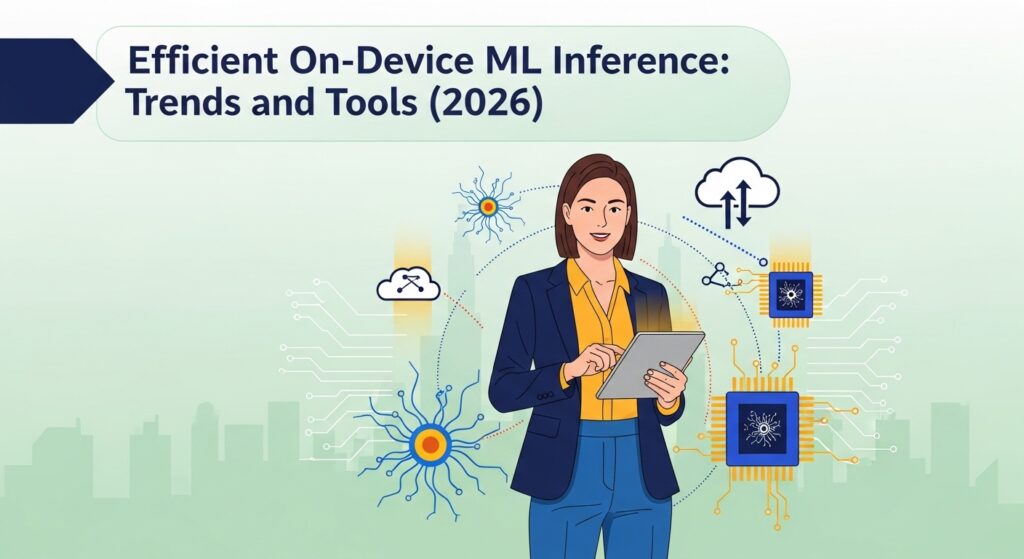
We are finally moving past the era where every single “AI” request needs to go on a round-trip to a data center in Virginia. It is about efficient on-device ml inference. It means the smarts stay right in your pocket.
I reckon we are seeing a massive shift here in 2026. Last year was all about the hype. This year is about making it work without draining your battery in twenty minutes. It is hella important for privacy too.
Thing is, building these apps is not like it used to be. You cannot just slap an API call on it and call it a day. You need to understand how the silicon actually thinks.
The NPU arms race is fair dinkum getting wild
Back in the day, we just threw everything at the GPU. Now, every flagship chip from Qualcomm to Apple has a dedicated Neural Processing Unit (NPU). These bits of silicon are built for one thing only.
The Snapdragon 8 Elite and the latest Dimensity 9400 are pushing insane TOPS (Tera Operations Per Second) numbers. They are basically built to run Small Language Models (SLMs) like they are nothing. It is brilliant.
Teams working in this space, like those at mobile app development company california have seen first-hand how NPU-native apps outperfrom legacy cloud-reliant ones. It is a completely different game for user retention.
If your app feels sluggish, you are basically “all hat and no cattle” as they say in Texas. You have the branding but none of the actual performance. Users in 2026 simply will not wait for the cloud.
Small Language Models (SLMs) are the new cool kids
Who needs a 175-billion parameter model to summarize a grocery list? Nobody. That is who. We are seeing a massive surge in models under 3 billion parameters. Think Llama 3.2-1B or Phi-4-Mini.
These models are tiny enough to fit into the RAM of a standard smartphone without crashing the operating system. They are specialized. They do one or two things exceptionally well rather than trying to know everything.
According to Qualcomm, local inference can reduce latency by up to 80% compared to cloud-based solutions. That is a massive difference when you are trying to provide real-time feedback.
I find it mildly cynical that we ever thought sending every word we spoke to the cloud was a good idea. SLMs give us that privacy back while keeping the speed. It is about time, mate.
ExecuTorch is finally sorted
For a while, getting a PyTorch model onto a mobile device was a nightmare. It was a proper mess of conversion errors and memory leaks. But Meta’s ExecuTorch has changed the landscape for developers.
It allows for a seamless workflow from research to deployment. You can take a model trained on massive H100 clusters and shrink it down for a portable NPU. It uses a much smaller runtime than previous iterations.
The framework supports various backends, including Apple’s Core ML and Qualcomm’s AI Engine. This means you do not have to write bespoke code for every single handset on the market. That saves heaps of time.
| Feature | Cloud Inference | On-Device Inference (2026) |
|---|---|---|
| Latency | Variable (100ms+) | Low (<20ms) |
| Privacy | Data leaves device | Zero-leakage possible |
| Cost | Per-token billing | Free (Hardware limited) |
| Availability | Requires Internet | Works Offline |
Quantization is not just for math nerds anymore
Get this. You do not need 32-bit precision for most ML tasks. Quantizing a model down to 4-bit or even 1.58-bit (binary) weights is how we make the magic happen. It shrinks the file size.
When you reduce the precision, you lose a tiny bit of accuracy. But you gain a massive amount of speed. In most mobile use cases, the user will never notice the difference in quality.
Research published on arXiv regarding BitNet b1.58 shows that these extreme quantization methods can match the performance of full-precision models. It is absolutely gnarly technology that makes edge AI viable.
But wait, it is not just about weight reduction. It is about memory bandwidth. Mobile chips are often choked by how fast data moves from RAM to the processor. Quantization helps alleviate that bottleneck.
Why the cloud is starting to feel a bit dodgy
Don’t get me wrong. The cloud is great for training. But for efficient on-device ml inference, it is becoming a liability. Reliability is the big one here. Servers go down.
When a major cloud provider has an outage, half the “smart” apps on your phone turn into bricks. That is not a good user experience. It makes developers look like they don’t know what they are doing.
Plus, the cost of running inference for millions of users at scale is astronomical. In 2026, companies are realizing they can save millions by offloading that compute to the user’s own hardware.
“The shift toward hybrid AI—where the device handles the immediate, personalized tasks and the cloud handles the heavy lifting—is the only way the economics of generative AI actually scale.” — Cristiano Amon, CEO of Qualcomm, Qualcomm Official Blog
Personalization without the “creepy” factor
We all want our apps to know us. We want them to anticipate our needs. But we do not want Mark Zuckerberg or whoever else reading our private thoughts to do it. Local ML solves this.
By training a small adapter on your local data, an app can become incredibly tailored to you. All that personal info stays in the secure enclave of your processor. It never hits a server.
This “On-Device Learning” is the next frontier. It means your phone is fixin’ to become an actual personal assistant, not just a window into someone else’s server farm. I am stoked for that.
Apple Intelligence changed the rules for everyone
When Apple decided to integrate Private Cloud Compute and local models into the OS, it forced the entire industry to catch up. They set the standard for what “safe” AI looks like.
Their latest M-series and A-series chips have unified memory that allows for massive throughput. This makes efficient on-device ml inference much easier on an iPhone than on a fragmented Android ecosystem. Usually.
But the Open Source community is fighting back. Projects like MLC-LLM are making it possible to run high-performance LLMs on almost any hardware with a decent Vulkan or Metal driver. It is proper brilliant.
💡 Andrej Karpathy (@karpathy): “The ‘Llama-3-8B in your pocket’ moment is the real milestone for AI utility. When the model is local, the latency and privacy enable entirely new UI paradigms.” — X/Twitter Insight (Paraphrased for Context)
The hardware co-design revolution
We are no longer just making software that fits on hardware. We are making hardware that fits the software. Google’s Tensor chips are a prime example of this philosophy. They prioritize ML performance.
This co-design approach means the silicon has specific instructions just for things like Attention mechanisms or Transformers. It is much more efficient than using general-purpose instructions for everything.
The result? Better battery life. If your phone gets hot every time you use a smart feature, that app is going to get deleted. It is as simple as that, no cap.
How to optimize for the edge right now
- Use Pruning: Remove neurons that do not contribute much to the output.
- Apply Knowledge Distillation: Train a small “student” model using a massive “teacher” model.
- Optimize for Memory: Reduce the footprint of your weights so they stay in the cache.
- Leverage 4-bit Weight Quantization: This is the current sweet spot for performance vs accuracy.
💡 Pete Warden (@petewarden): “The most valuable AI is the AI that can run on a $1 microcontroller with a year-long battery life. Edge compute is about democratization, not just speed.” — Pete Warden’s Blog
The “Un-Clouding” of the mobile app ecosystem
Expect to see more “offline first” labels on the App Store this year. It is becoming a badge of honor. People are tired of being tethered to a data connection for every little thing.
For those in mobile app development, this is a steep learning curve. You need to learn how to manage device memory like it is the 1990s again. But the reward is an app that feels like magic.
I find it hilarious that we spent twenty years moving everything to the cloud, and now we are spending billions to bring it all back. What a wild ride it has been, eh?
Future Trends: What to expect in 2027
Looking ahead, the market for edge AI is expected to grow by nearly 30% annually as efficient on-device ml inference becomes the standard, according to data from MarketsandMarkets. By 2027, we will likely see “Action Models” that can actually navigate your phone’s OS to complete tasks for you, entirely locally. The integration of 1.bit quantized models will become the industry standard for wearable tech, like glasses and watches, which have even stricter power budgets. We are moving toward a world where the ‘internet’ part of the internet is only for communication, not for the thinking itself.